
In founding the Knights of Columbus, Blessed Michael McGivney sought to
respond to the crisis in family life affecting Catholics in 19th-century America.
As a young man he witnessed firsthand the challenges his widowed mother faced
with seven children at home. Later, as a priest, he confronted on
a daily basis the problems affecting the families of his parish community due
to poverty, violence, alcoholism, immigration, anti-Catholic prejudice and
discrimination.
Blessed Michael McGivney’s vision for family life was not only that each
family might find financial and material aid. He understood that holiness is the
calling of all baptized Christians. And considering that two brothers followed
him into the priesthood, we can understand how truly important the sanctuary
of the home was to the McGivney family.
His family was a living example of what the Second Vatican Council later
taught: Each man, woman and child is called to holiness through proclaiming
the Gospel and communicating the divine gift of love in the activities of their
daily lives.
When Christian families respond in this way to the design of the Creator,
they become a “domestic church” that, as Pope Paul VI explained, mirrors “the
various aspects of the entire Church.”
The modern family recently has been a topic of particular focus for
the Church, with the two-year Synod on the Family and the post-synodal
exhortation by Pope Francis, Amoris Laetitia (The Joy of Love). During this time,
the Knights of Columbus has been involved in supporting families in their
Christian vocation through our new Building the Domestic Church While
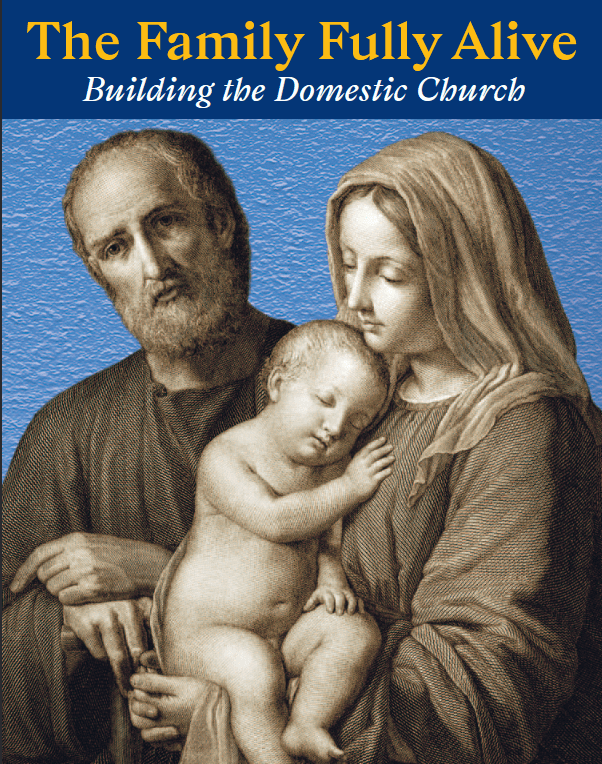
Strengthening Our Parish initiative. This initiative, which includes The Family
Fully Alive program, is designed to help families become more centered on their
task of serving God, neighbor and parish.
Since the Second Vatican Council, and especially during the pontificate of
St. John Paul II, it has become clear that the family is “the way of the Church.”2
In one sense, this obviously means that the family is the object of the Church’s
evangelization efforts.
But the Christian family too has its own indispensable mission. As
St. John Paul II wrote in Familiaris Consortio, “The family has the mission to
guard, reveal and communicate love.”3 This mission is at the heart of the
“community of life and love”4 that begins with the married couple in the
sacrament of matrimony.
To lead us in that mission we are fortunate to have a guidebook — Pope Francis’
exhortation Amoris Laetitia — to help us build the Catholic family as a domestic
church. In Amoris Laetitia, Pope Francis describes the Church as “a family of
families.”5 He reminds us to view the family as the sanctuary of life and love that
is at the heart of the domestic church.6 Our Knights’ families can take special
guidance from Pope Francis as he calls us to a new “family apostolate” based
upon “joy-filled witness as domestic churches.”7 Our parish-based councils also
have a role in connecting men and their families with the parish.
The Catechism of the Catholic Church tells us, “Conjugal love involves a
totality, in which all the elements of the person enter. … It aims at a deeply
personal unity, a unity that, beyond union in one flesh, leads to forming one
heart and soul.”8 In other words, sacramental marriage involves not just an
agreement between the spouses but a radical transformation of the spouses.
As Pope Benedict XVI wrote in Deus Caritas Est, “Marriage based on an
exclusive and definitive love becomes the icon of the relationship between God
and his people and vice versa. God’s way of loving becomes the measure of
human love.”
In this way, the witness of husband and wife within the daily life of the family
can guard, reveal and communicate love as they make their own the gifts of
marriage — unity, indissolubility, faithfulness and openness to new life.
A Vatican document on the role and mission of the family states, “The family
needs to be rediscovered as the essential agent in the work of evangelization.”10
It also points to the necessity to better understand the “missionary dimension
of the family as a domestic church.”
These observations echo those of St. John Paul II, who said, during a meeting
with the Latin American bishops in 1979, that “in the future, evangelization will
depend largely on the domestic church.”
Clearly, the role of the family in the work of evangelization is not primarily a
matter of programs, projects or strategies. These all have their place, but they are
secondary. Their place is to be at the service of what is essential — the love
between a husband and wife that, sanctified through the love of Christ, radiates
to each member of their family.
The family as domestic church is a place of encounter with Christ within the
community of a particular Christian family — a place where each member of
the family has an important role.
The “mission” of the family in the task of evangelization is to be what it is
called to be — that is, to live its daily life as a Christian family. As St. John Paul II
said so often, “Families, become what you are!”
The family’s mission to “guard, reveal and communicate love”— like the
parish community — does not exist in an ideal place. The truth and beauty of
the family must be communicated to every Christian family, even those that are
fragile, wounded or broken. These families too may read the words of St. Paul
with confidence: “Who shall separate us from the love of Christ?” (Rom 8:35).
And they may find in that confidence a path of hope and healing.
During his visit to the Philippines, Pope Francis cited the need for “holy and
loving families to protect the beauty and truth of the family in God’s plan and
to be an example for other families.”14 Our Building the Domestic Church
initiative and The Family Fully Alive monthly devotions are concrete ways that
Knights of Columbus, in solidarity with Pope Francis, can offer holy and loving
families for the Church’s mission of evangelization in our time.
Past Supreme Knight Carl Anderson


 Knights of Columbus - St. Charles Borromeo Council 17106