History of St. Charles Borromeo Parish
St. Charles Borromeo is a 2026 Bicentennial Jubilee Pilgrimage site!
“The Bicentennial Jubilee isn’t just a celebration of 200 years, it’s an invitation to reconnect with a faith that has the power to shape a city. It honors a legacy of faith that has guided generations while inspiring a future full of hope for all who call this Archdiocese home. Your Knights Council is proud to support our Parish and the Archdiocese of St. Louis!”
A short video about our Parish here:
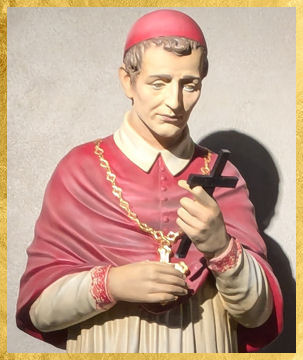
The history of St. Charles Borromeo Parish is deeply intertwined with the history of the city of St. Charles itself. Founded in the late 18th century, it is the third oldest parish in the Archdiocese of St. Louis, surpassed only by the Old Cathedral in St. Louis and Ste. Genevieve.
1. Foundations (1769–1791)
The parish’s roots date back to 1769, when Louis Blanchette and a group of French Canadians established a settlement along the Missouri River. Initially, religious life centered around a simple log cabin used for Mass by visiting priests. On October 13, 1789, the Spanish Lieutenant Governor, Don Manuel Perez, granted permission to build a permanent church in the village then known as Les Petites Cotes (The Little Hills). This vertical-log church was dedicated on November 7, 1791, at the corner of Jackson and South Main Streets. It was named for St. Charles Borromeo, the patron saint of King Charles of Spain.
2. Growth and the Second Church (1818–1852)
In 1818, the parish’s history was enriched by the arrival of St. Rose Philippine Duchesne and the Sisters of the Sacred Heart, who established the first educational system in the area. As the original log church began to deteriorate, a second structure was built at North Second and Decatur Streets. Constructed of white Burlington stone, it was the only church in the diocese at the time to be plastered.
During this era, the parish was served by notable figures such as Fr. P.J. Verhaegen, S.J., who was also the president of St. Louis University. In 1852, Fr. Verhaegen presided over the funeral of Mother Philippine Duchesne at this stone church.
3. The Third Church and the 1915 Storm (1869–1915)
By 1869, the congregation had outgrown the stone church due to heavy immigration (primarily of German, French, English, and Irish descent). A new brick church was commissioned at the current site (601 North Fourth Street). Though the cornerstone was laid in 1869, the building was not consecrated until 1872.
Tragedy struck on July 7, 1915, when a massive wind storm destroyed the main body of the brick church. Despite the extensive damage, the community rallied to rebuild immediately.
4. The Modern Era (1916–Present)
The cornerstone of the fourth and current church—the one standing today—was laid by Archbishop John Glennon on April 16, 1916.
- Jesuit Legacy: The Jesuit Order served the parish for many decades until May 6, 1957, when they departed to focus on missionary and educational work. Administration was then handed over to diocesan priests under Fr. Michael P. Owens.
- Expansion: Under diocesan leadership, the parish expanded significantly, including the building of a new school in 1958.
- Bicentennial Restoration: In 1989, the parish underwent a major renovation and restoration. It was re-sanctified on November 7, 1991, by Archbishop John L. May to celebrate the parish’s 200th anniversary.
Today, St. Charles Borromeo remains a vibrant, diverse community that continues to serve as a cornerstone of faith in the fastest-growing area of Missouri.
Please visit https://borromeoparish.com/About/History for more information.
 Knights of Columbus - St. Charles Borromeo Council 17106